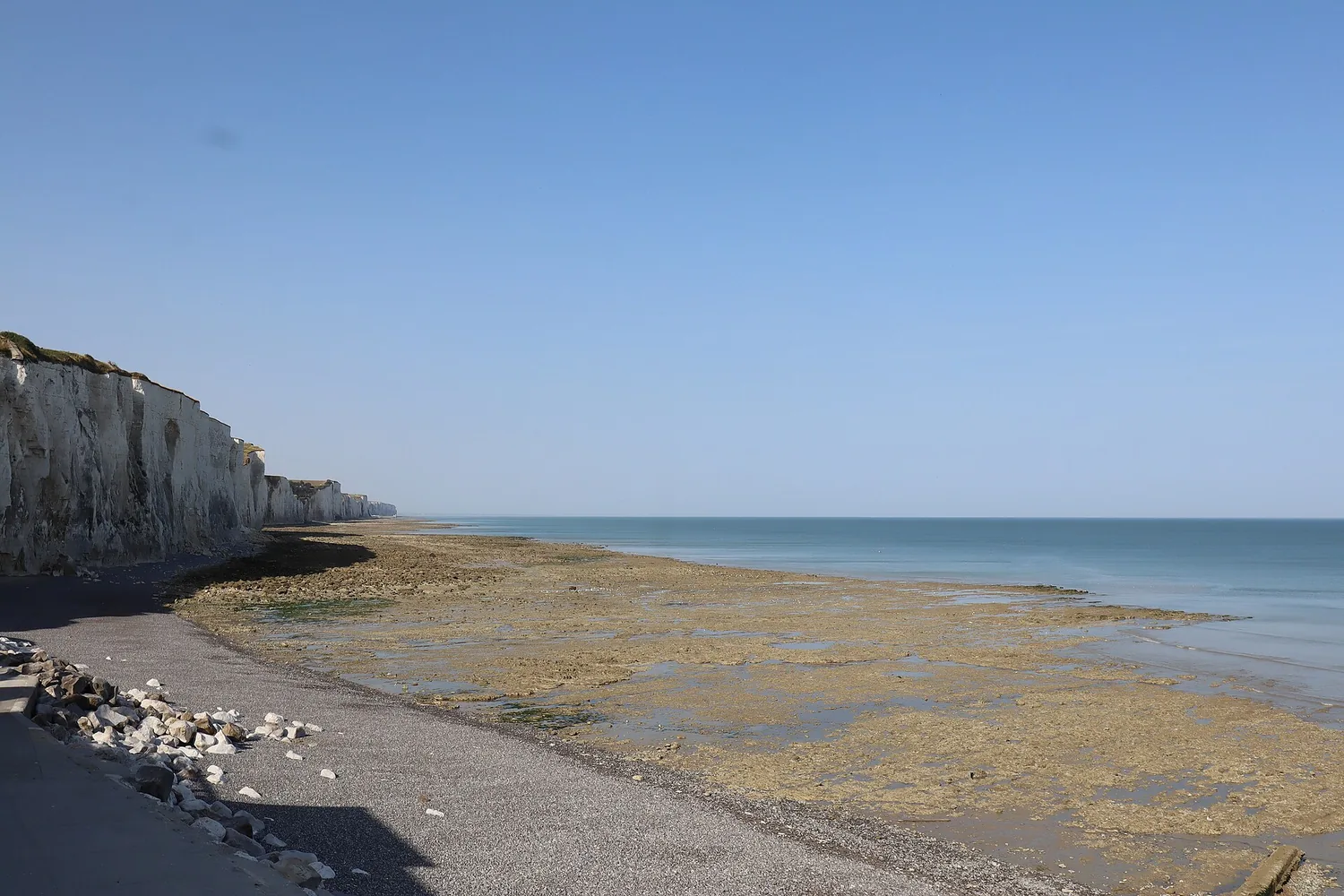
Arrive in Ault from the Baie de Somme and the scenery changes all at once: the flat land gives way to high white chalk cliffs running off towards the horizon. This is the exact point where the great cliffs of the Côte d’Albâtre — the Alabaster Coast — begin, the same cliffs that carry on all the way into Normandy. It is striking country, and it starts on foot from the Hôtel Aultia.
A chalk giant, millions of years in the making
The cliffs at Ault are made of chalk, a rock laid down in the Cretaceous period tens of millions of years ago by the slow accumulation of marine micro-organisms. Shaped by the sea, the wind and the storms, they are never quite the same twice: chalk is soft and fragile, and it erodes and retreats a little every year. It is this constant work of the elements that gives the coast its dramatic relief and its dazzling white walls.
From Ault into Normandy
At Ault begins a wall of chalk that unrolls southwards for dozens of kilometres. Nearby, the town of Le Tréport has some of the highest chalk cliffs in Europe. Further on, the Alabaster Coast runs all the way to the famous arches at Étretat. Ault is its northern gateway, still spared the crowds, and the site carries the national Grand Site de France designation.
The finest viewpoints
You do not need a long walk to take in the cliffs. From the sea wall and the clifftop road at Ault, the view drops straight down to the sea and along the whole line of chalk. A little higher, the lighthouse looks out over the village and the coast: this is where Victor Hugo liked to walk, held by the constantly changing light. For a greener outlook, head to the Bois de Cise close by, where the cliffs are framed by woodland.
The coastal path
To see the cliffs at close quarters, take the coastal path, clearly waymarked in yellow, which links Ault to Mers-les-Bains by way of the Bois de Cise — around 7 kilometres (4½ miles). It is easy going with no real difficulty, and every turn brings a new view of the sea and the chalk faces. Walk the whole route or just a section, depending on your mood and the light.
Safety: keep well back
For all their beauty, these cliffs are fragile. Chalk erodes, and rockfalls can happen without warning, both from the top and at the foot of the face. Always keep to the paths set back from the edge, do not walk up close beneath the cliff, and keep children within reach. The weather can turn very quickly: bring a windproof jacket and sturdy footwear.
When to come for the best light
The cliffs are worth seeing in any season. For photography, aim for sunrise or sunset, when the low light sets the chalk alight. Autumn and winter bring dramatic skies and near-empty cliffs, while spring and summer are made for long walks along the coastal path.
Further reading
Cliffs for a horizon. At the Hôtel Aultia, three hundred metres from the beach, the cliffs of Ault are your everyday view. After a day in the open air, come back to the comfort of a Belle Époque setting. Plan your stay and come and see where the Alabaster Coast begins.